> ## Documentation Index
> Fetch the complete documentation index at: https://docs.novu.co/llms.txt
> Use this file to discover all available pages before exploring further.
# Authentication
> Authenticate REST API requests with your Novu secret key, manage environment credentials, and follow security best practices.
The Novu REST API uses API key authentication. Every server-side request must include your environment's secret key in the `Authorization` header.
The REST API and server-side SDKs are intended for server-side applications only. Using them in client-side code causes Cross-Origin Resource Sharing (CORS) errors and exposes your secret key.
## API key authentication
Include your secret key in the `Authorization` header, prefixed with `ApiKey`:
```bash theme={null}
--header 'Authorization: ApiKey '
```
Example request:
```bash theme={null}
curl -X GET https://api.novu.co/v1/subscribers \
--header 'Authorization: ApiKey '
```
### Initialize the SDK
When using a server-side SDK, pass your secret key during initialization:
```javascript theme={null}
import { Novu } from '@novu/api';
const novu = new Novu({
secretKey: process.env.NOVU_SECRET_KEY,
});
```
Do not hardcode credentials in source code. Store your secret key in environment variables or a secrets manager.
## Credential types
Each Novu environment has two credentials. Use the right one for the context:
| Credential | Visibility | Used for |
| -------------------------- | ---------- | ------------------------------------------------------------------------------ |
| **Secret key** | Private | Authenticating REST API and server-side SDK requests |
| **Application identifier** | Public | Initializing the [``](/platform/inbox) component and client-side SDKs |
The secret key grants full administrative access to your environment. Never expose it in frontend code, public repositories, or browser network requests.
The application identifier is safe to use in client-side code. It identifies your application within Novu but does not authorize API requests on its own.
## Find your API keys
1. Log in to the [Novu Dashboard](https://dashboard.novu.co).
2. Go to **Developer** → **API Keys**.
3. Select the environment you want to use (Development, Production, or a custom environment).
Each environment has its own secret key and application identifier. Use the credentials that match the environment you are targeting.
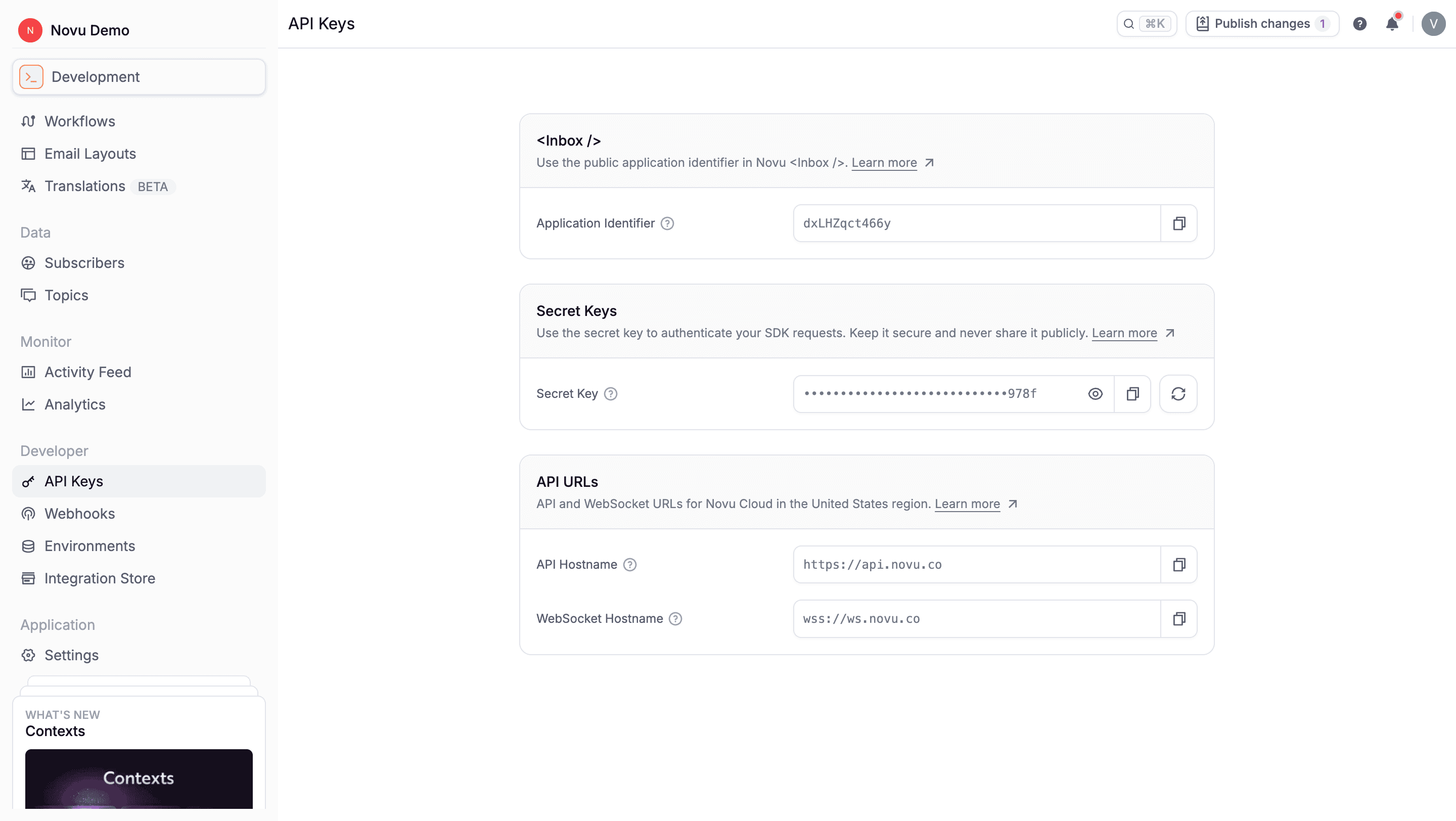 Learn more about application identifiers, secret keys, and API hostnames.
## Environment-specific credentials
API keys are scoped to a single environment. Requests authenticated with a secret key only access resources in that environment.
* **Development** — Build and test workflows, subscribers, and integrations.
* **Production** — Send live notifications to subscribers.
* **Custom environments** — Available on Team and Enterprise plans for staging, QA, or other release stages.
When you regenerate a secret key in the dashboard, the previous key is invalidated immediately. Update your environment variables before rotating keys in production.
## API base URLs
Use the base URL that matches your Novu Cloud region:
| Region | Base URL |
| ---------------- | --------------------------- |
| **US (default)** | `https://api.novu.co/v1` |
| **EU** | `https://eu.api.novu.co/v1` |
When using the EU region, also configure the WebSocket hostname for real-time Inbox updates:
| Region | WebSocket URL |
| ---------------- | ------------------------- |
| **US (default)** | `wss://ws.novu.co` |
| **EU** | `wss://eu.socket.novu.co` |
Self-hosted deployments use your own API hostname. See [Self Hosting Novu](/community/self-hosting-novu/overview) for configuration details.
## Security best practices
* Store secret keys in environment variables or a secrets manager — never commit them to version control.
* Use separate credentials for development and production environments.
* Rotate secret keys from the dashboard if a key may have been exposed.
* Restrict server-side API access to trusted backend services only.
* Enable [HMAC encryption](/platform/inbox/prepare-for-production#secure-your-inbox-with-hmac-encryption) for Inbox to prevent subscriber impersonation in client-side applications.
## Authentication errors
If authentication fails, the API returns a `401 Unauthorized` response. Common causes:
* Missing or malformed `Authorization` header
* Secret key from a different environment than the target resources
* Expired or regenerated secret key that has not been updated in your application
Verify that your header uses the `ApiKey` prefix (not `Bearer`) and that the secret key matches the active environment.
## Related documentation
* [Overview](/api-reference) — REST API capabilities and developer resources
* [Rate Limiting](/api-reference/rate-limiting) — Request limits by plan and endpoint category
* [Idempotency](/api-reference/idempotency) — Prevent duplicate requests by replaying responses for the same idempotency key
* [Environments](/platform/developer/environments) — How environments isolate resources and credentials
Learn more about application identifiers, secret keys, and API hostnames.
## Environment-specific credentials
API keys are scoped to a single environment. Requests authenticated with a secret key only access resources in that environment.
* **Development** — Build and test workflows, subscribers, and integrations.
* **Production** — Send live notifications to subscribers.
* **Custom environments** — Available on Team and Enterprise plans for staging, QA, or other release stages.
When you regenerate a secret key in the dashboard, the previous key is invalidated immediately. Update your environment variables before rotating keys in production.
## API base URLs
Use the base URL that matches your Novu Cloud region:
| Region | Base URL |
| ---------------- | --------------------------- |
| **US (default)** | `https://api.novu.co/v1` |
| **EU** | `https://eu.api.novu.co/v1` |
When using the EU region, also configure the WebSocket hostname for real-time Inbox updates:
| Region | WebSocket URL |
| ---------------- | ------------------------- |
| **US (default)** | `wss://ws.novu.co` |
| **EU** | `wss://eu.socket.novu.co` |
Self-hosted deployments use your own API hostname. See [Self Hosting Novu](/community/self-hosting-novu/overview) for configuration details.
## Security best practices
* Store secret keys in environment variables or a secrets manager — never commit them to version control.
* Use separate credentials for development and production environments.
* Rotate secret keys from the dashboard if a key may have been exposed.
* Restrict server-side API access to trusted backend services only.
* Enable [HMAC encryption](/platform/inbox/prepare-for-production#secure-your-inbox-with-hmac-encryption) for Inbox to prevent subscriber impersonation in client-side applications.
## Authentication errors
If authentication fails, the API returns a `401 Unauthorized` response. Common causes:
* Missing or malformed `Authorization` header
* Secret key from a different environment than the target resources
* Expired or regenerated secret key that has not been updated in your application
Verify that your header uses the `ApiKey` prefix (not `Bearer`) and that the secret key matches the active environment.
## Related documentation
* [Overview](/api-reference) — REST API capabilities and developer resources
* [Rate Limiting](/api-reference/rate-limiting) — Request limits by plan and endpoint category
* [Idempotency](/api-reference/idempotency) — Prevent duplicate requests by replaying responses for the same idempotency key
* [Environments](/platform/developer/environments) — How environments isolate resources and credentials