

appearance prop, which allows you to apply custom styles at different levels of control from predefined themes to component-level overrides.
The appearance prop supports the following keys:
baseTheme: Apply a predefined theme (for example, light or dark).variables: Define global styling properties (for example, colors, fonts).elements: Style individual UI components.icons: Replace default icons with custom ones.animations: Enable or disable UI animations. They’re on by default. See Customize animations.
Check out the Inbox Playground to see how the Inbox looks with common design presets. It showcases pre-styled variants like Notion and Reddit, which is helpful for seeing what’s possible before you start customizing.
Understand style injection
When rendered, the Inbox component automatically injects its styles into the<head> of the HTML document. If the component is rendered inside a shadow DOM, styles are scoped and injected into the shadow root instead.
This ensures that:
- Styles remain encapsulated and do not leak into global stylesheets
- No additional setup is required to manage scoped styling
Apply base theme
You can apply a predefined visual style to the entire Inbox UI by passing thebaseTheme object inside the appearance prop. This is a quick way to implement a dark mode or any base look and feel without redefining every variable.
Dark mode
Novu currently provides a built-in dark theme, which you can import from@novu/react/themes.
Define global variables
You can override the default styles in the Inbox component by passing avariables object inside the appearance prop. This is an efficient way to apply broad visual changes with minimal configuration.
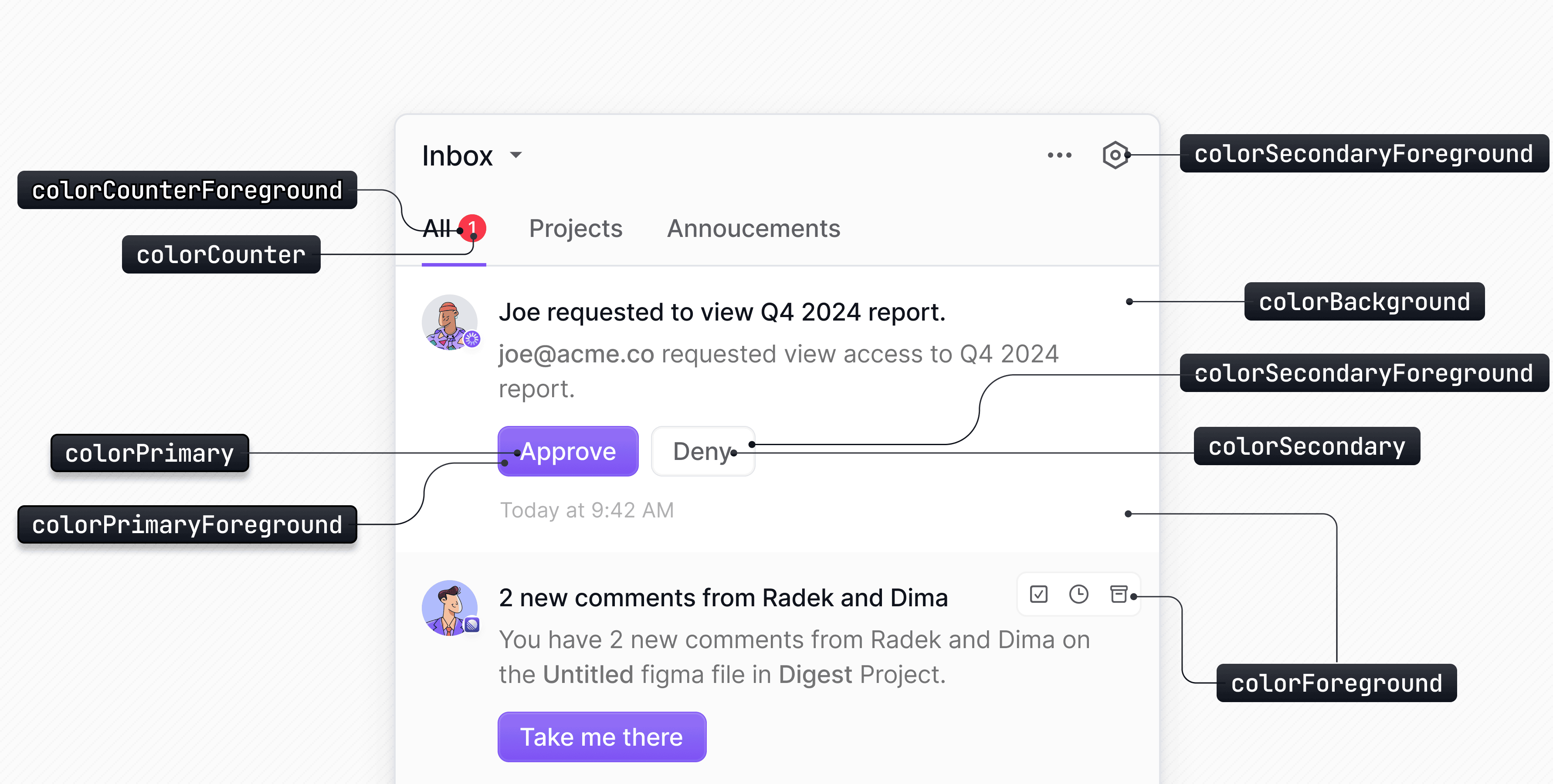
When both
baseTheme and variables are provided, variables always take precedence over the base theme.List of available variables
Development mode footer
When the Inbox connects to a Development environment or runs in keyless mode, Novu renders an animated striped gradient in the Inbox footer with a Development mode (or Keyless mode) label. Novu doesn’t render this footer for Production environments. In Production, the footer only shows the Novu branding, which you can remove on paid plans. To change the color of the striped footer, setcolorStripes in appearance.variables:
Style the Inbox UI elements
You can define styles for individual UI components within the Inbox UI by passing theelements object inside the appearance prop. Each key corresponds to a specific component, and the value can be either a style object or a set of CSS classes.
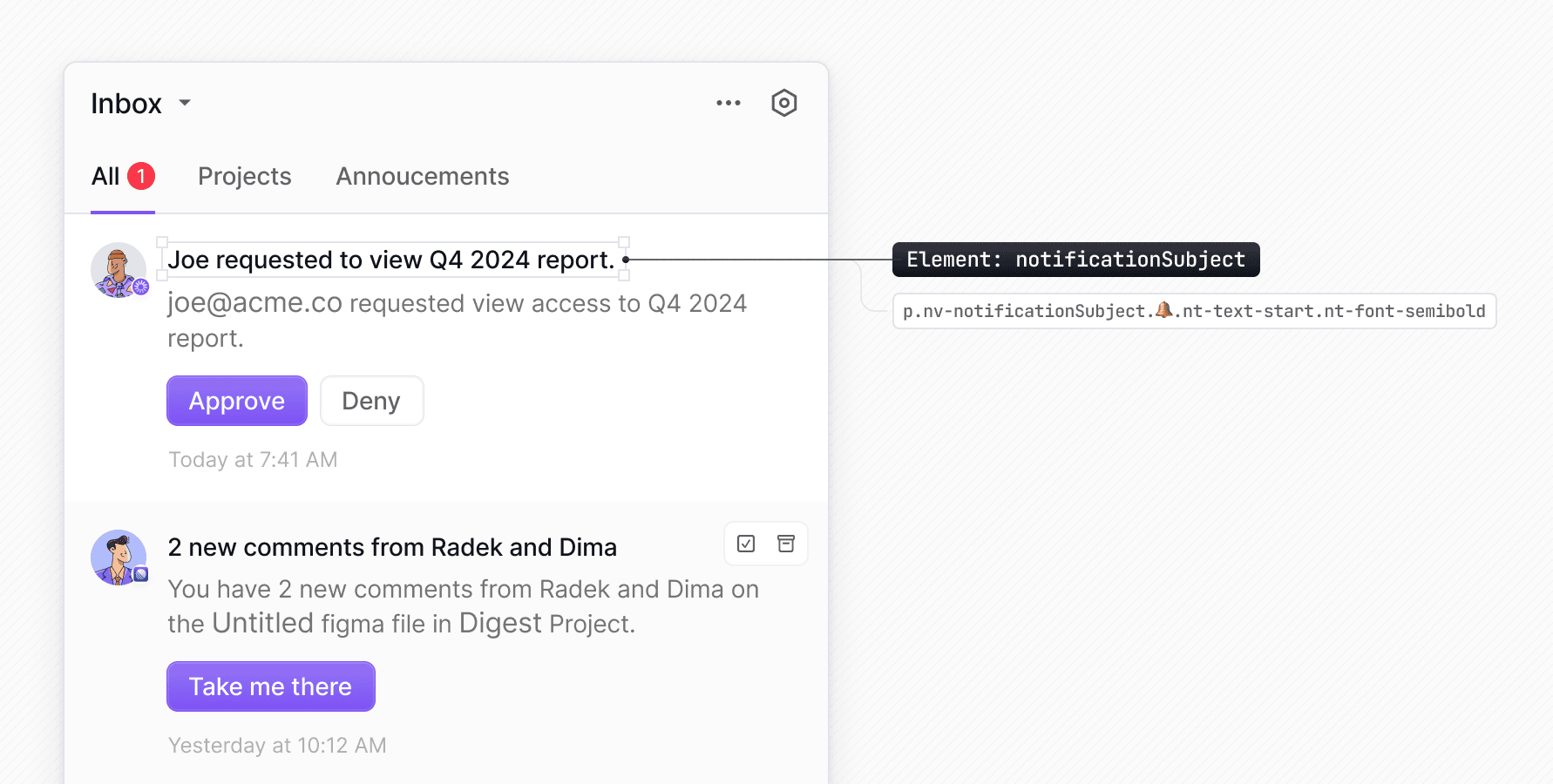
How to find other elements?Any selector that appears before the 🔔 emoji in the Devtools can be targeted via the
elements property in the appearance prop (stripping the nv- prefix). You can also use TypeScript autocomplete to find the available elements. For the complete list of Inbox element keys, see the React SDK appearance reference.- Style object
- Tailwind CSS
- CSS modules
You can pass inline styles to individual elements using the
elements object in the appearance prop. Each element accepts a style object.Apply styles dynamically using contextual callbacks
You can customize specific parts of the Inbox UI by providing callback functions for certain keys. This function receives contextual information such as unread counts, notification data, or preference details and lets you apply styles dynamically based on runtime values from your application.List of elements that can be customized using a callback function
List of elements that can be customized using a callback function
Style the bell icon based on unread count
You can change the bell icon color gradient based on the total number of unread notifications. The callback receives anunreadCount object, which is then used in the conditional logic.
Style notifications based on payload data
You can style individual notifications based on custom data in their payload. In the example below, the notification’s background color is changed if a specific field (foo) exists in the notification’s data object.Style notifications by severity
Notification severity comes with default visual styles, but you can fully customize how notifications look for each severity level using theappearance prop.
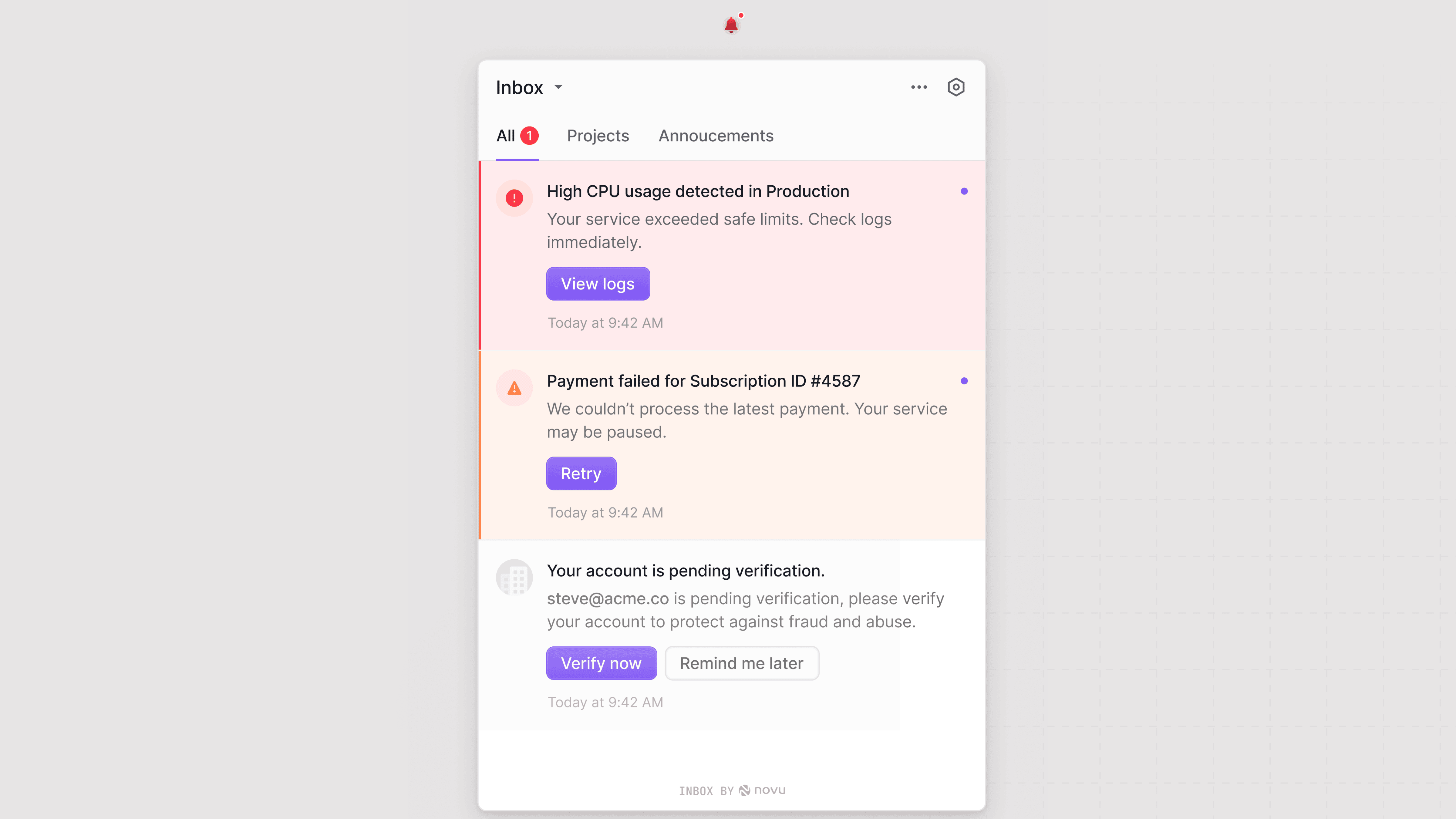
By default, the bell icon takes the color of the highest severity unread notification.
variables and elements objects to apply custom styling.
Customizing severity colors
You can override the default severity colors by setting new CSS custom properties in theappearance.variables object. Updating these variables automatically changes both the notification color and the bell icon color.
Customizing severity elements
You can apply specific styles to individual components using keys in theappearance.elements object. This lets you target components conditionally based on their severity state.
Customize animations
The Inbox animates its state changes. Menus and the Inbox popover grow out of the button that opened them and shrink back into it. When you switch between the notifications and preferences pages, or between tabs, the old view fades out and the new one fades in from the side it came from. The tab underline moves over to the selected tab. A notification you archive or snooze collapses out of the list instead of disappearing, and actions such as Archive all sweep the notifications out one after another. When the status filter changes, the list fades out and the new one fades in. Unread counts roll to their new value. Setanimations to false to turn every transition off:
animations to true doesn’t override that preference.
To retune the motion, override its CSS variables on the .novu root in a global stylesheet:
data-state="open" while they enter and data-state="closed" while they leave. Tab panels use active and inactive instead. Your styles take precedence over the built-in motion, so to remove the animation from a single element, set animation: 'none' for its key in appearance.elements:
animations: false.
Responsive Inbox using CSS media queries
On mobile and smaller devices, use theinbox__popoverContent element and apply a custom CSS class to it. Specify CSS media queries on this class and add the class in a global CSS file so that it takes effect. In the example below, media queries are applied to the novu-inbox-popover-content class in a global CSS file.
ResponsiveInbox.tsx
global.css