

Add step conditions
You configure step conditions from the Workflow Editor.- Select a step in the Workflow Editor.
- In the Configure step panel, click Step Conditions.
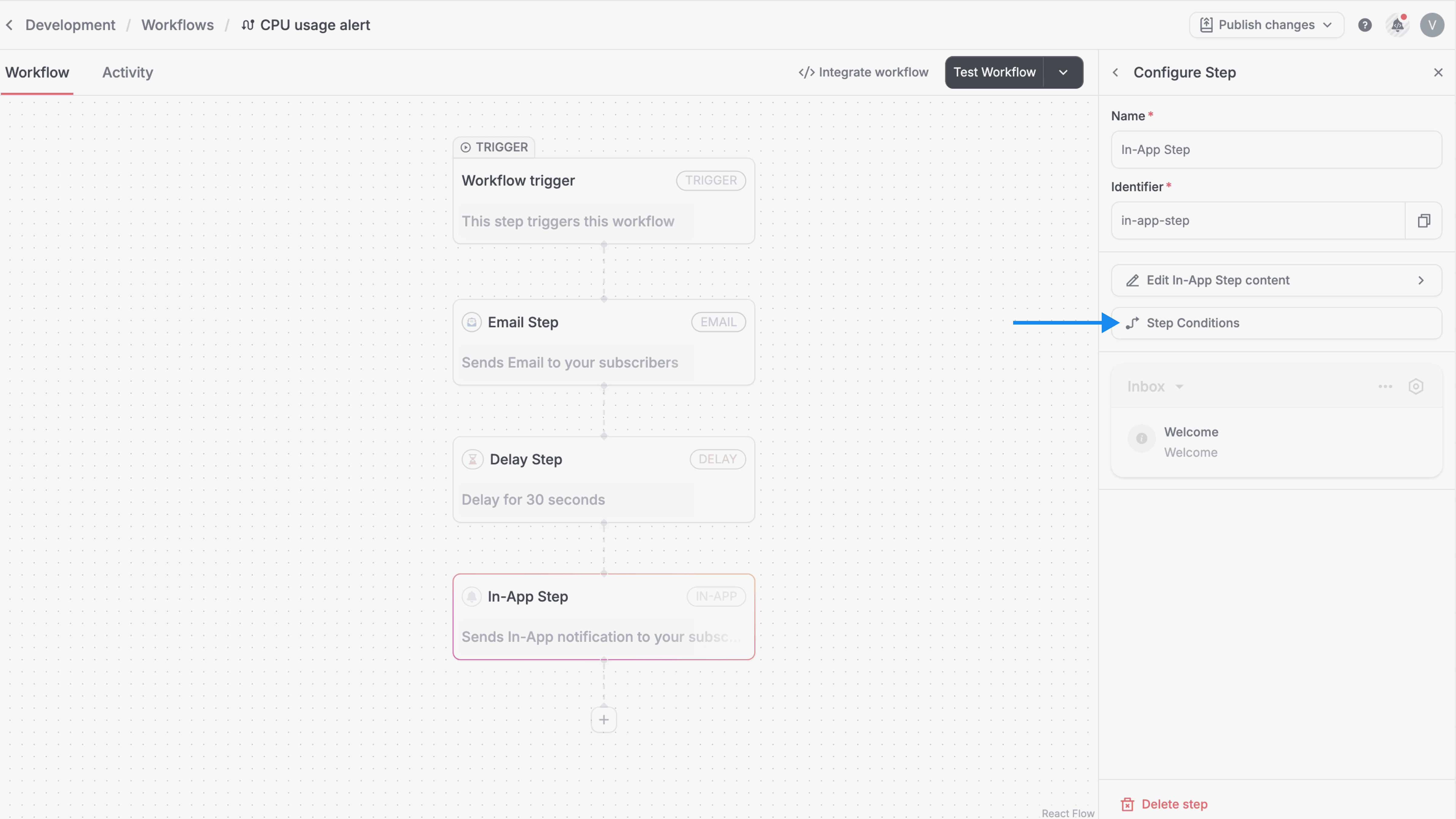
- Proceed to add your step conditions.
true, the step runs. If it evaluates to false, the step is skipped and the workflow continues.
Integration conditions are a separate control. They choose which provider integration sends the message after the step runs. See Integration conditions.
How the condition builder works
The step condition builder is rule-based and composed of three core elements:- Logical operators: Choose AND or OR to define how conditions are evaluated.
- Conditions: Individual rules that compare a field, an operator, and a value.
- Condition groups: Nested groups that allow more complex logic.
- AND / OR selector buttons
- + Add condition to add a rule
- Add group to create nested condition groups
Supported operators
The condition builder supports a wide range of comparison operators:
is empty and is not empty are available only for string fields. They check the exact string value, so
whitespace-only strings are considered non-empty. Missing fields,
null, arrays, objects, numbers, and booleans do
not match either operator.
Existing step conditions are unchanged. Saved equals, is null, and other operators keep the same result until
you add an is empty or is not empty rule.
Data used for step conditions
Step conditions can evaluate data from several sources. Choose the source that best represents the decision you’re trying to make.Subscriber data
You can apply conditions on subscriber attributes so notifications only go to the right people. For example, send an SMS only whensubscriber.isOnline is false (isOnline is a subscriber attribute that comes from whether the subscriber has an active Inbox session).
For custom fields you store on the subscriber (e.g. plan, preferences), use the full path to the property. For example, use subscriber.data.subscription_plan equals premium to run a step only for subscribers on the premium plan.
To learn more about Subscribers model, refer to the Subscribers documentation
Payload data
You can use data from the payload schema or custom payload data passed during the workflow trigger call to the Novu API to configure step conditions. This allows you to define dynamic rules based on the data unique to each workflow execution. Example payload data:payload.orderStatus = "completed"payload.totalAmount > 100
Workflow variables
You can base conditions on workflow variables. These variables provide metadata about the workflow being executed and allow you to add conditional logic.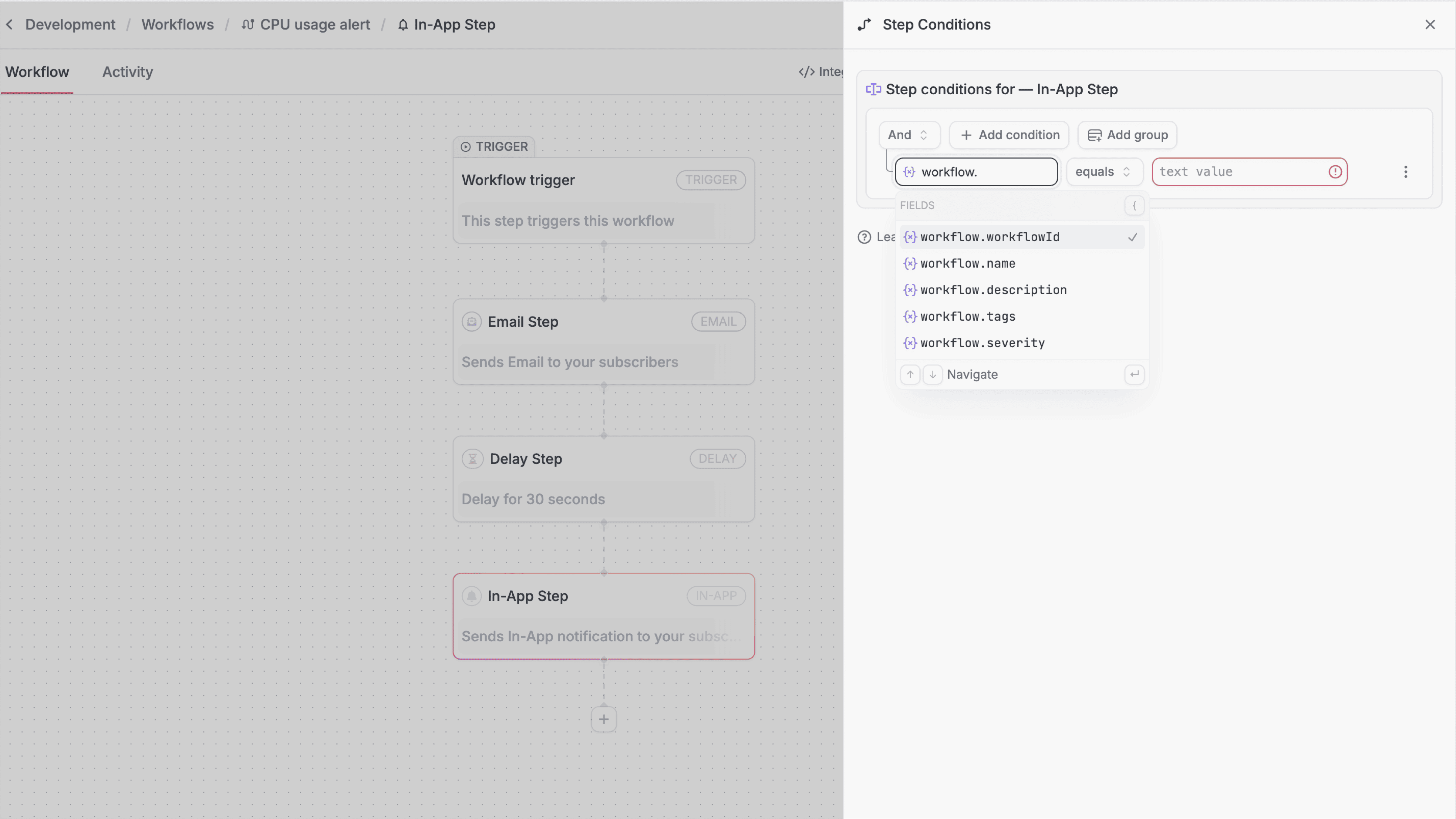
{{workflow.name}}: The name of the workflow.{{workflow.description}}: The description of the workflow.{{workflow.tags}}: An array of tags associated with the workflow.{{workflow.severity}}: The severity level (high, medium, low, none) of the workflow.{{workflow.workflowId}}: The unique identifier of the workflow.
Previous step result
For workflows involving sequential steps, conditions can also depend on the outcome of a previous step. If the prior step was an in-app notification, the condition can check:steps.<in-app-step-id>.seensteps.<in-app-step-id>.readsteps.<in-app-step-id>.lastSeenDatesteps.<in-app-step-id>.lastReadDate
Skip the email when the in-app notification was read
You can skip the email if the in-app notification was read:- Add an In-App step, then a Delay, then an Email step.
- On the Email step, open Step conditions.
- Require
steps.<in-app-step-id>.readto be false.
Context
You can use context variables in the Step conditions tab of a workflow step to add conditional logic to your notifications.To learn more about context, refer to the Context documentation.
Dynamic data fields
The value field in a condition can also be a dynamic data field. This allows you to compare two data points dynamically rather than using static values. For example:payload.foo is equal to payload.bar at runtime. This enables flexible condition logic based on real-time data comparisons.
Advanced application state calculationsFor more complex scenarios where you need to perform advanced calculations based on your application state, you can use the Novu Framework.